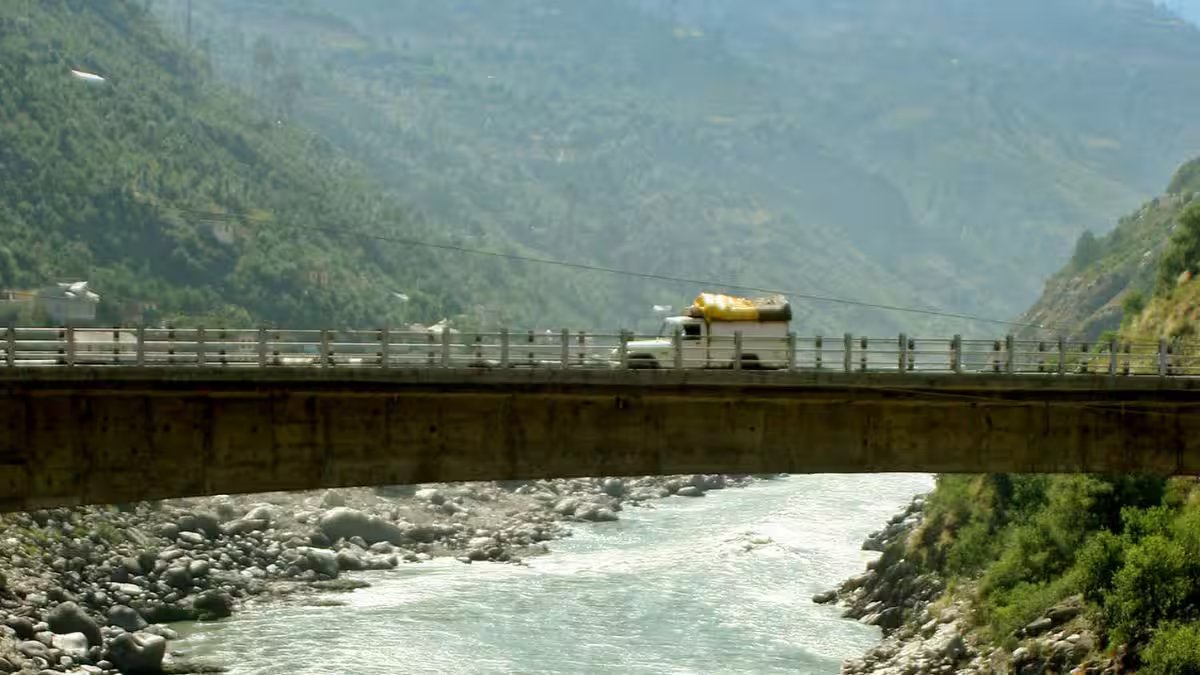
India has decided to advance the Dulhasti Stage-II hydropower project on the Chenab river.
Cleared by a key expert panel under the Union Environment Ministry in December, the project has become a flashpoint in India-Pakistan relations following New Delhi’s decision to place the Indus Waters Treaty (IWT) in abeyance early last year.
While Indian authorities describe the project as a technically compliant, run-of-the-river scheme aimed at strengthening energy security, Pakistan has responded with strong protests, accusing India of violating international agreements and destabilising the region.
At the centre of the controversy is the Chenab river, one of the three western rivers whose waters were allocated to Pakistan
under the 1960 Indus Waters Treaty.
With that treaty suspended in the aftermath of
the April Pahalgam terror attack, India has moved to expedite a series of long-pending hydroelectric projects in Jammu and Kashmir, of which Dulhasti Stage-II is among the most prominent.
What the environmental clearance enables
The 260-megawatt Dulhasti Stage-II Hydroelectric Power Project received its environmental clearance from the Expert Appraisal Committee (EAC) on hydel projects under the Ministry of Environment, Forest and Climate Change during the panel’s 45th meeting in December 2025.
The decision
was recorded in official minutes dated December 19, paving the way for the project developer to proceed with construction-related tenders.
The project is estimated to cost more than Rs. 3,200 crore, with some documents placing the figure at Rs. 3,277.45 crore.
Once tenders are floated and awarded, construction activity is expected to begin in the Kishtwar district of Jammu and Kashmir, where the existing Dulhasti power station is already operational.
In its assessment, the EAC acknowledged that the waters of the Chenab basin are shared by India and Pakistan under the framework of the Indus Waters Treaty of 1960 and noted that the design parameters of the project were drawn up in line with the treaty’s provisions.
However, the panel also explicitly recorded that “the Indus Water Treaty stands suspended effective from 23rd April, 2025”.
With the treaty no longer operational, New Delhi is not bound by earlier procedural obligations such as prior notification to Pakistan or the routine sharing of technical data related to river flows and new hydropower projects.
Why the Dulhasti project matters
The Dulhasti Stage-II project is not a standalone initiative.
It is planned as an extension of the existing Dulhasti Stage-I Hydroelectric Power Project, a 390 MW run-of-the-river scheme commissioned in 2007 and operated by the National Hydroelectric Power Corporation Limited (NHPC).
Stage-I has been generating more than 2,000 million units of electricity annually and forms a key part of the northern power grid, supplying peaking power to beneficiary states and regions including Jammu and Kashmir, Punjab, Haryana, Uttar Pradesh, Uttarakhand, Rajasthan, Delhi, and the Union Territory of Chandigarh.
The original Dulhasti project was conceived in 1985, with construction beginning the same year. Its journey to completion was marked by repeated delays and escalating costs.
Initially estimated at Rs. 1.6 billion, the project’s cost rose successively to Rs. 4.5 billion, Rs. 8 billion, Rs. 11 billion, Rs. 16 billion, and eventually Rs. 24 billion by the time it became operational on April 7, 2007.
The dam itself stands 70 metres high and stretches 186 metres in length, built in a rugged Himalayan terrain far from major urban centres.
The project diverts water from the Chenab river through a 9.5-kilometre-long headrace tunnel to the power station before discharging it back into the river.
It is equipped with low-level gated spillways that allow for the flushing of silt, a crucial feature given the heavy sediment load typical of Himalayan rivers.
Dulhasti Stage-II is designed to leverage this existing infrastructure. Rather than constructing an entirely new dam, the new stage will draw water from the Stage-I power station through a separate tunnel measuring 3,685 metres in length and 8.5 metres in diameter.
This tunnel will lead to a horseshoe-shaped pondage specifically created for Stage-II operations.
The project includes a surge shaft, a pressure shaft, and an underground powerhouse equipped with two generating units of 130 MW each, resulting in a total installed capacity of 260 MW for Stage-II.
How the Dulhasti Stage-II project will proceed
The Dulhasti Stage-II project is located in the Kishtwar district of Jammu and Kashmir, an area that has already seen significant hydropower development along the Chenab river.
According to information submitted to the Expert Appraisal Committee, the total land requirement for the project is 60.3 hectares.
Of this, approximately 8.26 to 8.27 hectares of private land will be acquired from residents of two villages — Benzwar (also referred to as Banzwar) and Palmar.
Official documents indicate that land acquisition will affect around 62 families, reported The Indian Express. A public hearing for the project was conducted on August 22, 2025, in Banzwar village, where the underground powerhouse is proposed to be located.
The clearance granted by the EAC is subject to a set of general and project-specific conditions.
Among these is the requirement to develop a river conservation strategy aimed at mitigating the impacts of altered hydrological regimes resulting from the combined operation of Dulhasti Stage-II and other upstream and downstream projects, including the Pakal Dul dam.
How India is actively prioritising the Indus basin
The timing of the clearance is closely linked to India’s broader strategy in the Indus river basin following the suspension of the Indus Waters Treaty.
Under the treaty, Pakistan exercised control over the waters of the Indus, Jhelum, and Chenab rivers, while India retained rights over the Ravi, Beas, and Sutlej.
Although the treaty permitted India to undertake non-consumptive uses of the western rivers — such as run-of-the-river hydropower projects — it also imposed strict design constraints and procedural requirements.
With the treaty now in abeyance, the Centre has moved to accelerate several long-pending projects that were earlier slowed by diplomatic, technical, or legal challenges.
These include major hydropower projects such as Sawalkote, Ratle, Bursar, Pakal Dul, Kwar, Kiru, and Kirthai-I and II.
The Sawalkote Hydroelectric Power Project, with a planned capacity of 1,856 MW, has been designated a “project of national importance” and is located on the Chenab river itself.
In July 2025, NHPC invited international tenders for Sawalkote, signalling the scale of India’s renewed push in the region.
Dulhasti Stage-II is therefore part of a wider effort to maximise hydropower generation in Jammu and Kashmir, assert greater control over river resources, and strengthen energy security at a time when water has become an increasingly strategic asset.
How Pakistan responded to the Dulhasti Stage-II clearance
Pakistani officials and political leaders have accused India of violating the Indus Waters Treaty and using water as a strategic weapon.
Former federal minister and Pakistan Peoples Party (PPP) leader
Sherry Rehman has been among the most vocal critics. Reacting to India’s move, she described it as a “serious weaponisation of the waters of the Chenab River”.
“This flagrantly transgresses the provisions of the Indus Waters Treaty,” the X page of the Office of Sherry Rahman said.
In another statement posted on the same platform, her office said, “India’s approval of the Dullhasti project on the Chenab River is a clear and grave violation of the Indus Waters Treaty. Any unilateral action on disputed rivers directly undermines Pakistan’s recognised water rights and poses serious threats to regional peace and stability.”
Rehman herself posted on X, “In flagrant violation of the Indus Waters Treaty (IWT), India has just given approval to the Dulhasti Stage-II hydropower project on the Chenab River in Indian Illegally Occupied Jammu and Kashmir (IIOJ&K).”
She added, “As per the IWT, which cannot be unilaterally revoked, as recent UN rapporteurs have confirmed, Pakistan has control over the waters of the Indus, Jhelum, and Chenab rivers, while the Ravi, Beas and Sutlej rivers fall under India’s control.”
Referring to India’s broader hydropower push, Rehman said, “Following the illegal suspension of the treaty, India has decided to fast-track several disputed hydroelectric projects in the Indus Basin. These projects include Sawalkot, Ratle, Bursar, Pakal Dul, Kwar, Kiru, and Kirthai-1 and 2. Dulhasti Stage-II is considered part of this strategy.”
She cautioned, “This weaponisation of water is neither sane nor acceptable in a region on the frontlines of climate change and environmental stress. It will inflame tensions in a bilateral relationship already bristling with hostility and distrust.”
Pakistani media outlets, including Geo TV, echoed this criticism, describing the clearance as a “flagrant violation of the Indus Waters Treaty”.
How Pakistan is alleging water flow manipulation
In recent weeks, Islamabad has
alleged that it is witnessing declining and erratic inflows from rivers such as the Chenab, Jhelum, and Neelum.
Pakistani authorities have claimed that abrupt holding and release of water upstream has led to sharp drops in inflows, threatening agriculture during the critical Rabi sowing season.
These allegations have been framed as a direct threat to Pakistan’s food security and rural livelihoods.
Following India’s suspension of the IWT, Pakistan warned that any attempt to stop or significantly alter river flows would be viewed as an “act of war”.
Islamabad later urged New Delhi to restore the treaty and proposed dialogue to renegotiate its terms. It has also written to the United Nations Security Council, accusing India of weaponising water resources.
There has been no immediate formal response from Pakistan’s Foreign Office specifically on the Dulhasti Stage-II clearance.
What next for Indus basin-based hydropower projects
The Chenab river basin is already one of the most heavily developed hydropower regions in the western Himalayas.
Environmentalists have raised concerns about the cumulative impact of multiple dams and run-of-the-river schemes on a single river system, particularly in the context of climate change.
Water bodies across the Himalayan region are experiencing rapid changes due to shifting precipitation patterns, glacial retreat, and rising temperatures.
The Chenab itself originates from the confluence of the Chandra and Bhaga rivers in Himachal Pradesh’s Lahaul and Spiti region before flowing through Jammu and Kashmir into Pakistan.
The EAC’s clearance conditions, including the requirement for a river conservation strategy, reflect official recognition of these concerns, even as India presses ahead with infrastructure development.
With inputs from agencies
End of Article