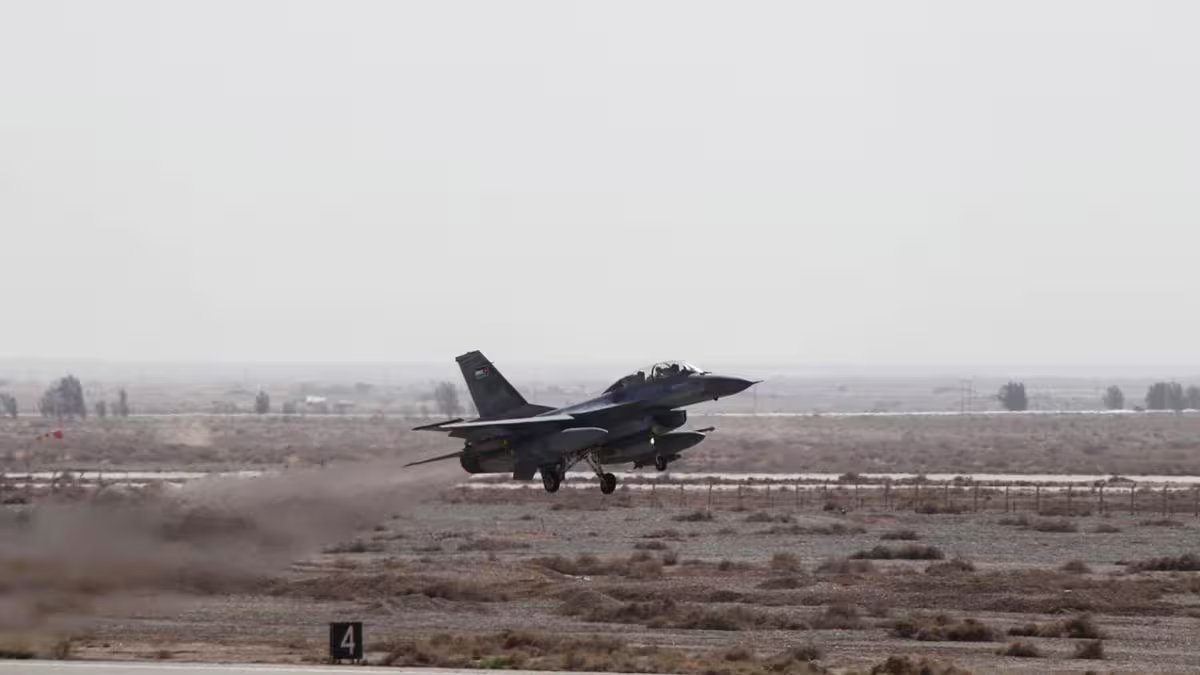
Jordan has struck arms and drug trafficking networks in the rural areas of Sweida in southwestern Syria. Last week, Jordan joined the United States to strike Islamic State’s personnel and facilities in Syria.
Jordan on Wednesday struck arms and drug trafficking networks in Syria.
This is the second time in the past week that Jordan has conducted strikes inside Syria. On Saturday, Jordan said it joined the United States to strike Islamic State’s personnel and facilities in Syria.
Without going into the specifics, the Jordanian military said it “targeted a number of factories and workshops used by arms and drug dealers”, according to AFP.
These strikes neutralised traffickers who were organising “arms and drug smuggling operations into Jordanian territory” and sites were “were destroyed based on accurate intelligence and in coordination with regional partners”, the Jordanian military said.
Separately, a resident of the border area in the southern countryside of Sweida told AFP that the Jordanian bombardment “was extremely intense and targeted farms and smuggling routes”.
Jordan is part of the 90-nation coalition combating the Islamic State in the region. Syria under President Ahmed al-Sharaa has also joined the bloc and pledged ‘political support’. It is not known if the Syrian administration was involved in the Jordanian strikes.
In a report, Syrian state broadcaster Al-Ikhbariya said the Jordanian military targeted “drug smuggling networks and storage farms in the southern and eastern countryside” of Sweida.
Syria has been a drug trafficking hub
It is not yet clear if Jordanian strikes targeted personnel and sites belonging to any designated terrorist group or the narcotics network that worked under Syria’s previous administration of Bashar al-Assad.
During the Syrian civil war that began in 2011, the ‘captagon’ drug (fenethylline) became the Syrian regime’s biggest export. Estimates suggest that captagon exports earnt the regime and its allies, such as Iran and its proxies like the Hezbollah in Lebanon, up to $2.4 billion a year.
The captagon has become infamous as the ‘jihadist drug’ in West Asia as jihadists use the drug as they believe it makes them fearless and ruthless.
Captagon is an amphetamine-based stimulant that is supposed to heighten alertness, suppress fatigue, and reduce fear. While it was made in the 1960s to treat excessive and irregular sleepiness, it was discouraged and banned by 1980s. But the drug became popular among jihadists and other extremists in West Asia.
Among the jihadists, the perception has been that the drug allows them to fight longer and be less hesitant to engage in violence.
Over the years, the drug has flooded the region and Syria’s neighbours have occasionally announced seizures and asked Lebanon and Syria to ramp up efforts to combat the illicit trade, according to AFP.
End of Article