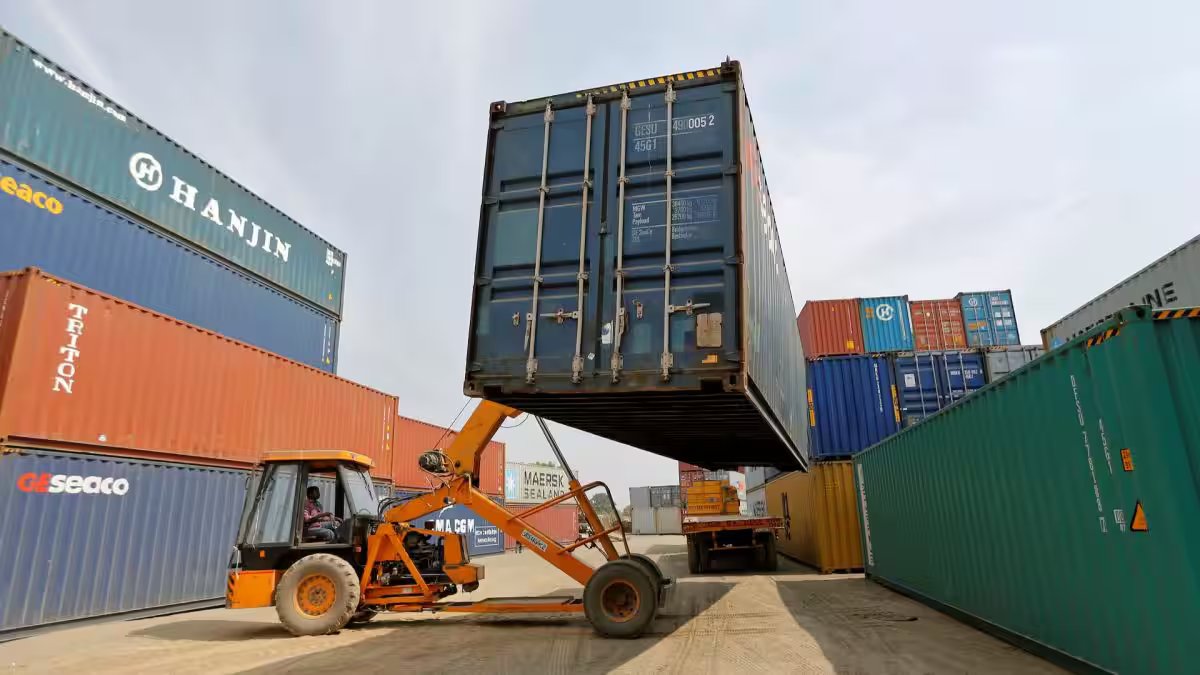
Rising protectionism, US tariffs and Europe’s carbon border tax are tightening pressure on India’s export engine in 2026
From Donald Trump’s Liberation Day tariffs to geopolitical turmoil, 2025 will be remembered as a year rocked by multiple disruptions, with trade uncertainty emerging as one of its defining features. But 2026, which nations are now set to enter, is likely to mirror many of the same challenges. What stands out, however, is how developing nations like India are standing tall—battling trade-related uncertainties and demonstrating resilience.
The government has spoken of an ambitious $1 trillion export target, covering both merchandise and services exports. However, given the global trade environment, achieving this milestone appears increasingly difficult, according to a report by the Global Trade Research Initiative (GTRI).
“For FY26, merchandise export growth is expected to be stagnant, with pressure from US tariffs impacting demand. There could be some respite, with a faint chance of services exports surpassing $400 billion, but overall exports are unlikely to breach $850 billion. This makes the government’s $1 trillion target look distant in a slowing and increasingly protectionist global economy,” the report said.
In FY25, India’s total exports stood at around $825 billion, with merchandise exports at $438 billion and services exports at $387 billion.
According to GTRI, amid rising trade uncertainties, developing economies like India are diversifying their export destinations. “While exports to the US have declined sharply, exports to the rest of the world have risen by about 5.5% during the same period, indicating that Indian exporters are actively seeking new markets,” the report noted.
However, the US and the European Union remain India’s most critical export destinations, and complete disengagement is not a viable option. In China’s case, where India runs a trade deficit close to $100 billion, the priority must be to boost exports rather than merely curbing imports.
It is not just the US that poses challenges. Europe has emerged as an equally tough hurdle, with the European Union’s Carbon Border Adjustment Mechanism (CBAM) set to become operational from January 1, 2026. CBAM effectively imposes a carbon charge on imports. Its impact is already visible, with Indian steel exports to the EU declining by around 24%, driven largely by compliance and reporting requirements.
“Going ahead in 2026, Indian products will have to be priced by EU importers inclusive of CBAM costs, with payments to be settled through the surrender of certificates in 2027,” the GTRI report highlighted.
Trade diplomacy on the move
Despite widespread disruption on the trade front, trade diplomacy has shown agility and remains one area of momentum. This is reflected in the pace at which India has been signing free trade agreements (FTAs). Over the past four years, India has concluded six FTAs with partners including Mauritius, the UAE, EFTA nations, Indo-Pacific Economic Framework countries, the UK, Oman and New Zealand—taking the total number of comprehensive FTAs to 18.
FTA fervour in 2026
“Moving into 2026, India may enter into trade arrangements with major economies such as the United States, the European Union, Russia and Mexico,” the GTRI report said. According to Ajay Srivastava, founder of GTRI, if these negotiations fructify, India would have trade agreements with almost all major global economies, except China.
“However, the immediate agenda must be to ensure that existing FTAs begin delivering results—by promoting exports and integrating Indian businesses into global supply chains—rather than remaining diplomatic achievements on paper,” Srivastava said.
The report further highlighted that if India is to become truly export-competitive, it must focus on improving product quality and reducing costs. “Greater value addition will be essential in sectors such as electronics, engineering and textiles to sustain exports despite deteriorating global conditions,” it said.
Srivastava believes that in 2026, performance will matter more than promises. Effective execution of the Export Promotion Mission, regulatory simplification and improvements in ease of doing business, he said, will determine whether Indian exports merely survive or find room to expand in the year ahead.
End of Article