India’s decision to sign a Comprehensive Economic Partnership Agreement (CEPA) with Oman marks a strategically timed shift in its external trade policy, as New Delhi confronts an increasingly restrictive global trading environment shaped by higher tariffs.
Signed on Thursday in Muscat during Prime Minister Narendra Modi’s visit, the agreement reflects India’s effort to secure stable export markets with West Asia while reducing vulnerability to punitive duties imposed by the United States under President Donald Trump.
The India-Oman pact is the second major free trade agreement finalised by New Delhi in the past six months, following the trade deal with the United Kingdom in May.
Why the India-Oman CEPA matters
US import tariffs on Indian goods at the moment stand at 50 per cent and talks with Washington are yet to yield a breakthrough.
United States is
India’s largest export destination. These tariffs include a retaliatory component tied to India’s continued purchases of discounted Russian crude oil, which Washington argues indirectly supports Moscow’s war effort in Ukraine.
The impact has been particularly pronounced in sectors such as textiles, auto components, metals and other labour-intensive industries, which rely heavily on price competitiveness.
While India and the US had hoped to finalise the first tranche of a bilateral trade agreement by the fall, negotiations stalled amid diplomatic strains, leaving exporters exposed to elevated trade barriers.
Against this backdrop, New Delhi has moved more aggressively to finalise trade agreements elsewhere. The Oman deal fits into this broader recalibration, aimed at spreading export risk across a wider set of markets and reducing dependence on any single partner.
India currently has 15 free trade agreements covering 26 countries, along with six preferential trade agreements, and is negotiating with more than 50 other partners, trade analyst Ajay Srivastava told AP.
Once ongoing talks are completed, India is expected to have trade arrangements with nearly all major global economies, with China remaining the notable exception.
What the India-Oman CEPA signing signals
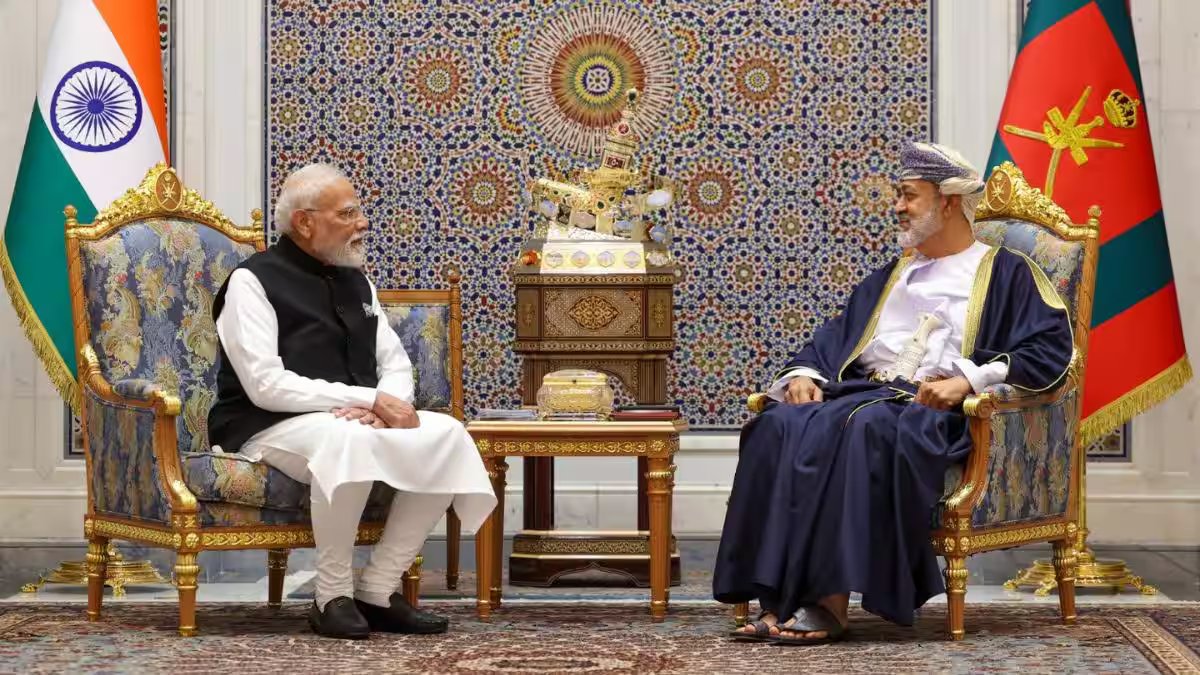
The CEPA was signed in Muscat by India’s Commerce and Industry Minister Piyush Goyal and Oman’s Minister of Commerce, Industry and Investment Promotion Qais bin Mohammed Al Yousef. The
signing ceremony was attended by Modi and Oman’s head of state, Sultan Haitham bin Tarik.
Under the leadership of Prime Minister @NarendraModi ji and His Majesty Sultan Haitham bin Tarik, India and Oman have inked the India-Oman Comprehensive Economic Partnership Agreement (CEPA), marking a significant milestone in India’s strategic engagement with the Gulf region.… pic.twitter.com/VI2RzSpO2O
— Piyush Goyal (@PiyushGoyal) December 18, 2025
The presence of the two leaders highlighted that the pact extends beyond trade liberalisation and reflects a broader commitment to strengthening bilateral ties.
Oman occupies a strategically important position at the mouth of the Strait of Hormuz, the narrow waterway between Oman and Iran through which a significant share of global oil shipments pass.
Addressing the significance of the agreement, Modi said, “This (pact) will set a new pace of our trade, add new trust to our investments and open doors to new opportunities in many sectors.”
For Oman, the agreement carries its own importance. It is Muscat’s first bilateral trade deal since concluding an agreement with the United States in 2006.
The India-Oman agreement also comes as negotiations have stalled between New Delhi and the Gulf Cooperation Council (GCC) as a bloc.
While talks for a comprehensive trade deal with the six-member GCC did not materialise, India
now has trade agreements with two GCC members — the UAE and Oman.
Other GCC countries include Bahrain, Kuwait, Qatar and Saudi Arabia, with discussions expected to continue in various formats.
What the India-Oman CEPA comprises
Under the agreement, Oman has committed to
granting zero-duty access on more than 98 per cent of its tariff lines.
These concessions cover 99.38 per cent of India’s exports to Oman by value, with immediate tariff elimination applying to nearly 98 per cent of product categories.
The scope of tariff elimination spans all major labour-intensive industries.
Indian exports in sectors such as gems and jewellery, textiles, leather, footwear, sports goods, plastics, furniture, agricultural produce, engineering goods, pharmaceuticals, medical devices and automobiles will face no import duties in Oman once the agreement comes into force.
Previously, many of these products attracted import duties of around five per cent, which limited price competitiveness.
India, on its part, has agreed to reduce or eliminate tariffs on 77.79 per cent of its total tariff lines, amounting to 12,556 product categories. These concessions account for nearly 95 per cent of India’s imports from Oman by value.
Products of export interest to Oman but considered sensitive for India, such as dates, marbles and petrochemical products, will receive market access largely through tariff-rate quotas rather than complete duty elimination.
To protect domestic producers, India has placed several items on an exclusion list. These include dairy products, tea, coffee, rubber, tobacco, gold and silver bullion, jewellery, footwear, sports goods and scrap of various base metals.
Officials have indicated that these safeguards are intended to balance trade liberalisation with domestic economic priorities.
The agreement is expected to take effect in the first quarter of 2026, providing businesses on both sides with a defined timeline to plan market entry and expansion.
How India-Oman trade is faring
India and Oman currently record annual trade of over $10 billion.
In the 2024-25 financial year, bilateral trade stood at approximately $10.5 billion, with Indian exports valued at about $4 billion and imports at $6.54 billion.
Oman is India’s third-largest export destination among the GCC countries.
Indian exports to Oman have shown steady growth in recent years. Shipments of machinery and related parts have doubled over the past five years, rising from roughly $3 billion to $6 billion.
Other key Indian exports include naphtha and petrol, aircraft, rice, iron and steel products, beauty and personal care items, and ceramic goods.
Oman’s exports to India are dominated by energy-related products and industrial inputs. These include crude oil, liquefied natural gas, fertilisers, petroleum coke and chemical inputs such as methyl alcohol and anhydrous ammonia.
Many of these items are critical for India’s energy and industrial sectors and already benefit from relatively low tariffs under India’s existing trade arrangements.
Industry bodies expect the CEPA to unlock fresh opportunities in specific sectors.
The gems and jewellery industry, which has been particularly affected by tariff-related disruptions in the US market, is expected to benefit from improved access to Oman and potentially onward markets.
The agreement could also strengthen India’s export position in the wider Arab region, where exporters face fewer regulatory and compliance hurdles compared to markets such as the European Union.
Indian exporters have long argued that stringent standards and environmental regulations in the EU, including the proposed carbon border tax, act as non-tariff barriers that raise costs and limit competitiveness.
How the India-Oman CEPA also boosts the service sector
Oman’s global imports of services are estimated at $12.52 billion, but India’s share currently stands at just over five per cent.
Under the CEPA, Oman has offered commitments across a broad range of service sectors, including computer-related services, professional and business services, audio-visual services, research and development, education and health services.
The agreement allows Indian companies to hold 100 per cent foreign direct investment in major service sectors in Oman through commercial presence, creating scope for deeper and more sustained engagement.
The services chapter also includes provisions aimed at facilitating the temporary movement of skilled professionals. For the first time, Oman has made extensive commitments under Mode 4, which governs the mobility of professionals.
The quota for intra-corporate transferees has been increased from 20 per cent to 50 per cent, while the permitted duration of stay for contractual service suppliers has been extended from 90 days to two years, with the possibility of an additional two-year extension.
More flexible entry and stay conditions will apply to professionals in fields such as accountancy, taxation, architecture, medical and allied services.
These measures are intended to enable closer collaboration between Indian and Omani firms and support the expansion of Indian service providers in the local market.
The CEPA builds on long-standing people-to-people and economic links between India and Oman. Nearly seven lakh Indian nationals live and work in Oman, making them one of the largest expatriate communities in the country.
Remittances from Oman to India are estimated at around $2 billion annually, contributing to household incomes and foreign exchange inflows.
Indian businesses also have a substantial presence in Oman, with more than 6,000 Indian establishments operating across various sectors.
In terms of investment flows, India has received over $615 million in foreign direct investment from Oman between April 2000 and September 2025.
What next for India’s FTA push
The CEPA with Oman is part of a broader push by India
to secure global trade agreements.
In recent years, India has signed comprehensive economic cooperation and trade agreements with the United Arab Emirates and Australia, both of which have led to a rise in bilateral trade.
In May, India and the United Kingdom
announced the conclusion of a long-negotiated free trade agreement that will significantly reduce tariffs on products such as Scotch whisky and English gin exported to India, as well as Indian food items and spices entering the UK market.
Negotiations are also
ongoing with the European Union, New Zealand and Chile.
In recent weeks, senior trade officials from these regions have held meetings with Indian counterparts to review progress and explore ways to move talks forward.
At the same time, India’s trade negotiations with the US is facing setbacks, but there have been signs of easing tensions.
Modi has publicly welcomed Trump’s peace initiative aimed at resolving the Russia-Ukraine conflict, and the two leaders have spoken by phone to discuss areas of mutual interest, including trade.
A US delegation led by Deputy Trade Representative Rick Switzer
recently visited New Delhi for discussions with Indian officials.
Despite the accelerated pace of negotiations, challenges remain for India’s trade policy. Negotiators are under pressure to ensure that market opening does not come at the expense of small farmers and domestic industries.
Sensitive sectors continue to be protected through exclusion lists and calibrated concessions.
With inputs from agencies
End of Article