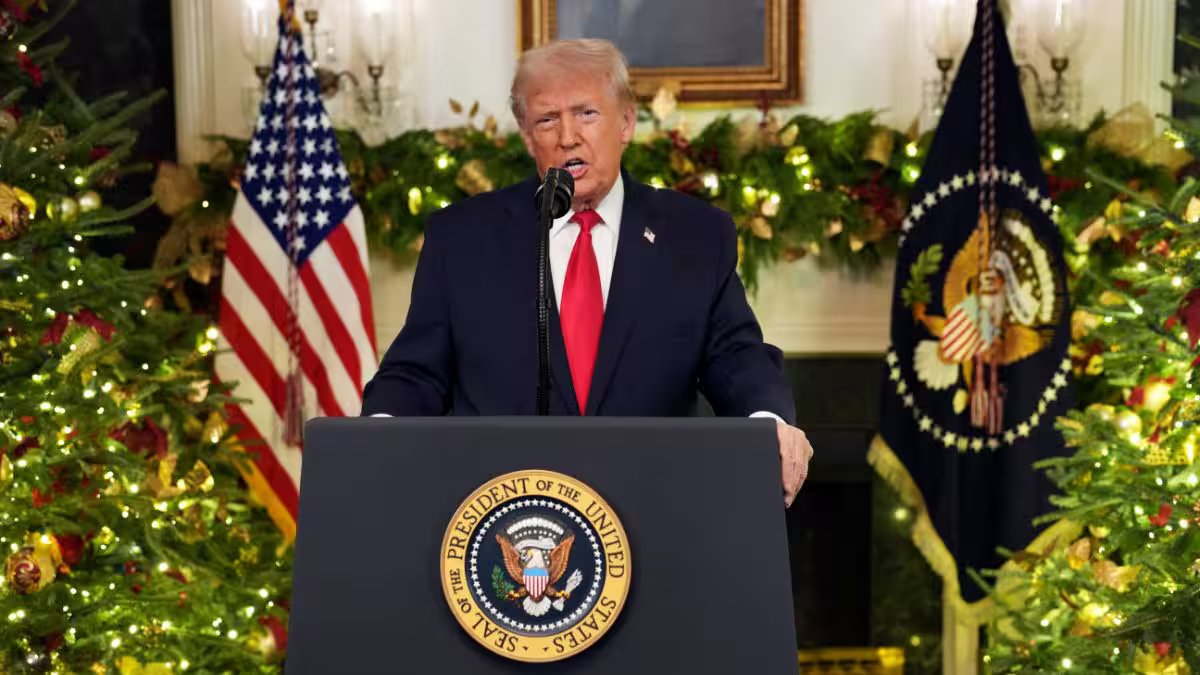
United States President Donald Trump used a nationally televised address from the White House just days before Christmas to present his first year back in office as a period of recovery and momentum, even as public unease over the economy persists and his party faces a high-stakes electoral test in 2026.
The roughly 20-minute speech, broadcast live in prime time, avoided some of the most pressing foreign policy issues confronting his administration.
The address was delivered against a festive backdrop but carried a distinctly combative tone, reflecting a presidency increasingly focused on defending its economic record and reassigning blame as inflation ticks upward and approval ratings slide.
Trump blames Biden
Trump opened his remarks with a line that set the tone for the entire address. “Good evening, America. Eleven months ago, I inherited a mess, and I’m fixing it.”
The statement encapsulated the core argument he returned to repeatedly throughout the speech: that the economic and social difficulties Americans are experiencing today
are the result of decisions made by his predecessor, former US President Joe Biden.
Over the course of the address, Trump referred to Biden multiple times while linking a wide range of challenges to the previous administration.
Rising living costs, crime, healthcare pressures and immigration policy were all attributed to Democratic leadership, reinforcing a narrative Trump has consistently employed since returning to office.
This framing came as many Americans continue to report strain from higher prices for groceries, housing, utilities and holiday expenses.
“What a difference a year makes,” he said, adding that the country is “poised for an economic boom the likes of which the world has never seen.”
Trump defends his economic agenda
Trump asserted that inflation is easing, incomes are growing and investment is flowing into the country at an accelerating pace.
To reinforce the message, Trump brought charts with him to the podium, using visual aids to argue that the economy is improving and that global leaders view the United States as a top destination for capital.
He repeated a claim he has made frequently at rallies and public appearances, saying foreign officials have told him that “we’re the hottest country anywhere in the world.”
Trump also suggested that manufacturing investment commitments would translate into job creation and that consumer spending would rise as Americans receive larger tax refunds next year.
However, publicly available economic indicators suggest a more mixed reality. Inflation, which had been declining after reaching a four-decade high in 2022, has begun climbing again since Trump announced new import tariffs earlier this year.
The consumer price index is currently rising at an annual rate of 3 per cent, compared with 2.3 per cent in April.
Since April’s “Liberation Day,” when Trump announced a sweeping set of import taxes that were later suspended and revised, monthly job growth has averaged just 17,000. Over the same period, the unemployment rate has increased from 4 per cent in January to 4.6 per cent.
While the stock market has posted gains, gasoline prices have declined and technology firms are making major investments in artificial intelligence, these positive indicators have not translated into broader public confidence.
On healthcare, Trump blamed Democrats for the expected rise in insurance premiums as subsidies tied to the Affordable Care Act are set to expire.
Although some Democratic lawmakers and a number of Republicans have sought legislative solutions, Trump has resisted those approaches, instead suggesting that payments should go directly to consumers rather than insurance companies.
Trump announces one-time payments
Trump acknowledged frustration over rising prices but rejected the idea that his policies were contributing to the problem. Economists, however, have pointed to tariffs as a factor pushing up consumer costs, particularly for imported goods.
Trump nonetheless defended the trade measures and suggested they would generate revenue to fund new initiatives.
One such initiative formed the one policy announcement of the speech. Trump said his administration would
distribute one-time payments of $1,776 to approximately 1.45 million active-duty US military personnel as a holiday bonus.
He referred to the payment as a “warrior dividend,” explaining that the amount was chosen to mark the upcoming 250th anniversary of the signing of the Declaration of Independence in 2026.
“The checks are already on the way,” Trump said, adding that the programme would cost roughly $2.6 billion.
Trump’s speech not behind the Oval Office desk
The speech was delivered from the White House’s Diplomatic Reception Room, rather than the Oval Office, allowing Trump to stand behind a podium rather than sit at a desk.
He was positioned between two US flags, flanked by Christmas trees and green garland, with a portrait of George Washington visible behind him.
Despite the seasonal setting, the tone of the address was largely devoid of holiday warmth. Trump did not dwell on themes of unity or shared sacrifice, nor did he express empathy for Americans struggling with affordability.
His holiday greetings were brief and confined to the closing moments of the speech, when he wished viewers “Merry Christmas” and a “Happy New Year.”
Rather than adopting the measured cadence typical of presidential addresses to the nation, Trump appeared focused on energizing supporters and reinforcing familiar talking points.
Trump brings up old grievances
Presidential speeches carried live on network television have traditionally been less overtly partisan than campaign events. In this case, however, Trump delivered what many viewers recognised as a condensed version of his rally rhetoric.
He revisited cultural grievances, including complaints about men participating in women’s sports, and repeated claims about having restored order to schools by confronting what he described as radical ideologies.
He also spoke about immigration enforcement, crediting himself with halting border crossings even as his mass deportation efforts have proven unpopular in public opinion surveys.
Trump also criticised Somali immigrants in Minnesota, accusing them of stealing from the United States, a line of attack that mirrors language he has used previously.
The partisan tone stood in contrast to past decisions by television networks to avoid broadcasting presidential addresses deemed overly political. In September 2022, for example, networks declined to air a prime-time speech by Biden on democracy because of concerns about its campaign-like character.
Trump ignores foreign policy
Despite ongoing international crises and recent escalations involving Venezuela, foreign policy received relatively little attention.
In the days leading up to the address,
Trump had increased pressure on Caracas, including issuing a social media post ordering a “total and complete blockade” of “sanctioned oil tankers” travelling to or from Venezuela.
The move raised questions about whether the administration was considering more aggressive action against President Nicolás Maduro.
Some of Trump’s allies had speculated that the speech might clarify his intentions. Instead, the president offered no detailed discussion of Venezuela and did not address whether he would seek to force Maduro from power.
Trump did briefly mention his work in West Asia and portrayed himself as a peacemaker, but these references were fleeting. The overall emphasis remained firmly on domestic economic issues.
Trump’s advisers have warned him in recent weeks that continued focus on international disputes risks alienating voters who are primarily concerned about everyday expenses.
And the cameras stopped rolling
In 2026, voters will decide control of the House and Senate in midterm elections that will serve as a referendum on Republican leadership.
Recent electoral setbacks have raised questions about the durability of Trump’s coalition, making the national address an opportunity to regain momentum.
When the broadcast ended, Trump reportedly turned to his aides to ask for feedback on his performance. They assured him the address had gone well. He then
referenced White House chief of staff Susie Wiles, saying she had urged him to speak to the nation.
After some exchange, Trump asked Wiles directly how he had done. “I told you 20 minutes and you were 20 minutes on the dot,” Wiles said.
With inputs from agencies
End of Article