The Bangladesh Election Commission is preparing to formally announce the date of national polls on Thursday.
The upcoming vote, slated for February 2026, will take place at a time when the nation is still grappling with the aftermath of an unprecedented political transition triggered by the 2024 student-led uprising that removed Sheikh Hasina from power after more than a decade and a half in office.
The political turbulence of the past year has created a landscape that is unlike any Bangladesh has faced since its independence.
For India, the stakes are exceptionally high.
Bangladesh is not merely a neighbouring state; it plays an indispensable role in India’s border security and strategic counter-balancing in the subcontinent.
When the 2024 uprising changed Bangladesh
Bangladesh’s political order was upended in mid-2024, when protests reached a boiling point across cities over disputes related to government job quotas.
What started as agitation over recruitment norms quickly spiralled into a massive nationwide campaign against the Hasina administration.
Demonstrations expanded through the summer months and eventually led to violent confrontations between protesters and security forces.
By August, the crisis had expanded beyond the government’s capacity to manage, and on August 5, 2024,
Sheikh Hasina stepped down and left the country. The clashes associated with the upheaval left hundreds of people dead and thousands more injured.
Following her departure, an interim structure was put in place to manage day-to-day governance and prepare the nation for a fresh electoral exercise.
Nobel laureate Muhammad Yunus was appointed to lead this transitional government alongside a group of student leaders and advisers who had emerged during the anti-government mobilisations.
One of the defining developments under the interim arrangement was a decision to introduce significant institutional reforms. These were encapsulated in a document that came to be known as the “July Charter,” drafted shortly after the unrest.
The charter outlines a broad range of restructuring efforts intended to curb concentrations of political power and strengthen institutional checks. These reforms propose limiting the authority of the executive branch, establishing greater independence for the judiciary and election authorities, and ensuring that law-enforcement bodies cannot be used to target political rivals or dissenters.
A nationwide referendum on the charter is
expected to take place on the same day as the parliamentary vote.
During the months following the uprising, the interim administration moved to bar the Awami League — the country’s most enduring political organisation since independence — from participating in the next general election.
This occurred after amendments to anti-terror legislation and subsequent legal actions resulted in the suspension of the party’s registration and restrictions on its political activities.
This decision removed from the political field the only party that had maintained consistently warm ties with New Delhi for more than a decade.
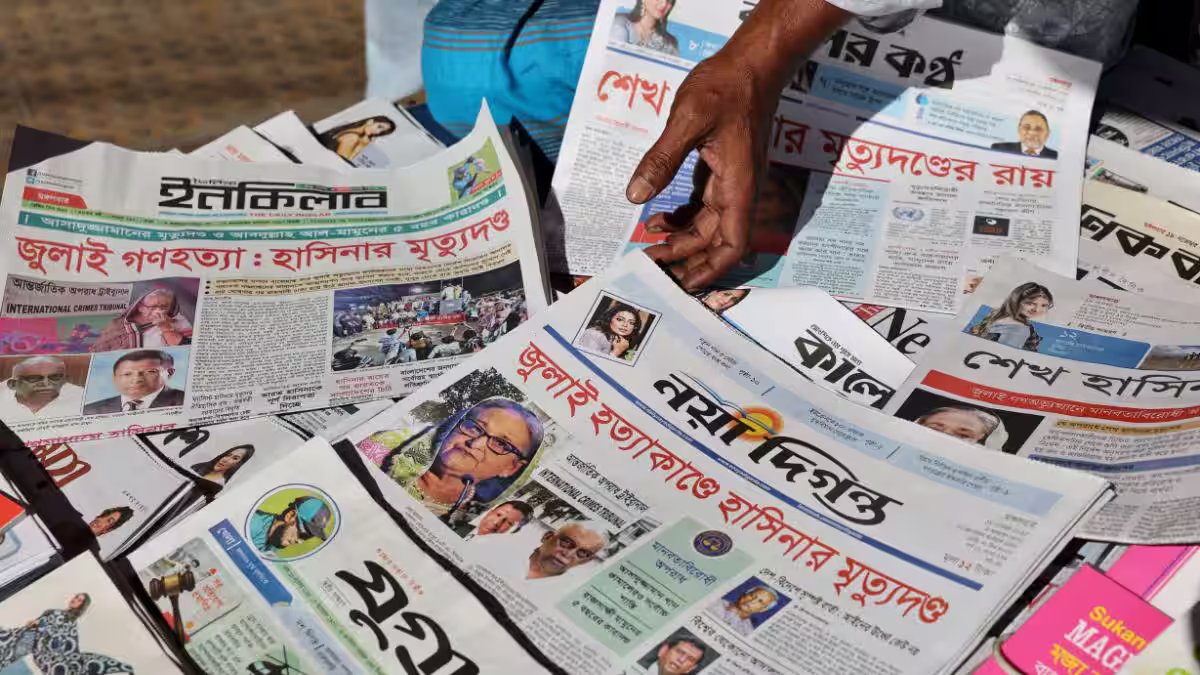
Sheikh Hasina, who fled to India during the violence, was later tried in absentia and convicted by the International Crimes Tribunal in November earlier this year for crimes against humanity
and subsequently sentenced to death.
Her continued residence in India has since become
one of the most sensitive issues in the bilateral relationship.
Why India is following the 2026 election closely
Important trade routes
Bangladesh functions as India’s most important land bridge to its northeastern region.
Transport corridors across Bangladeshi territory provide efficient connectivity to Assam, Tripura, Meghalaya and Mizoram,
reducing dependence on the narrow Siliguri Corridor — the vulnerable connector that links the Northeast to the rest of India.
In recent years, road, rail, and inland waterway links through Bangladesh have become essential to economic development in India’s border states.
Bangladesh is also India’s largest trade destination in South Asia, with exchanges exceeding $15 billion. India exports machinery, raw materials, consumer goods, and services, while medical tourism from Bangladesh also forms a substantial revenue stream.
Bilateral trade has remained steady despite political changes, and Bangladeshi products continue to receive tariff concessions in the Indian market.
Stability in India’s East & North-East
Dhaka is also indispensable to India’s Act East Policy. Bangladesh
hosts the BIMSTEC Secretariat, making it a key node for maritime and regional cooperation in the Bay of Bengal.
Stability in Bangladesh reinforces India’s strategic positioning across Southeast Asia and the wider Indo-Pacific.
A significant aspect of India-Bangladesh ties under Hasina was deep coordination on counter-insurgency. During her tenure, Bangladesh dismantled militant camps linked to groups such as ULFA and NDFB and handed over important insurgent leaders.
Cooperation under the
2013 Extradition Treaty and the 2015 Land Boundary Agreement was instrumental in limiting cross-border criminal and militant networks. Bangladesh’s support substantially curtailed activities that once destabilised India’s northeastern states.
However, the removal of Hasina has introduced new uncertainties. Analysts on both sides of the border have raised concerns that the shifting political environment may allow previously weakened groups to reorganise.
Early indications of infiltration attempts, potential militant regrouping, and an increase in Islamist influence have been cited by security practitioners. Some intelligence assessments suggest that external actors, including ISI operatives, may be attempting to re-establish footholds in districts near the border.
Growing Chinese presence in Dhaka
Another challenge for India arises from China’s expanding role in Bangladesh. More than $10 billion in Chinese investments are now spread across dozens of major projects throughout the country.
Yunus has described this financial engagement as a “game-changer,” signalling that the interim government views Chinese partnership as essential for Bangladesh’s development trajectory.
One project in particular has raised alarm within Indian security circles:
the possible revival of the Lalmonirhat Airbase with Chinese involvement. Located roughly 135 kilometres from the Siliguri Corridor, such a development could significantly alter regional security dynamics and heighten India’s strategic vulnerabilities.
For India, any strengthening of China’s footprint so close to a critical choke point represents a serious concern.
Tensions also worsened after Yunus referred to the Northeast as “landlocked” and Bangladesh as the “guardian of the ocean.”
Following those comments, India halted important transshipment facilities that Bangladesh relies on for its ready-made garment exports, causing economic friction.
Stalled connectivity projects between India & Bangladesh
Despite previous progress in regional integration, several connectivity initiatives have slowed following the political transition. The Ashuganj Inland Container Port upgrade remains on hold, impacting logistics operations vital to bilateral trade.
Meanwhile, the railway service planned along the Khulna-Mongla route has not yet started commercial operations. Various land ports along the India-Bangladesh border in the Northeast have reported disruptions, delaying trade and affecting local economies.
Such interruptions threaten to reverse the developmental momentum that had been building in India’s northeastern states, where enhanced integration with Bangladesh had begun to improve economic prospects and regional infrastructure.
What Bangladesh’s electoral landscape looks like now
With the Awami League’s exclusion, the February 2026 poll will be contested primarily by three significant players: the Bangladesh Nationalist Party (BNP), Jamaat-e-Islami (JI), and the National Citizen Party (NCP).
BNP’s determined re-entry
The BNP, historically the Awami League’s main rival, has spent much of this year rebuilding its organisational networks after boycotting the previous election cycle.
The party leadership — traditionally centred around Khaleda Zia and her family — has framed the upcoming election as a chance to restore competitive democracy.
It continues to emphasise “Bangladeshi Nationalism” as its guiding ideology and has positioned itself as the leading alternative in the present political environment.
In December 2025, the BNP demonstrated its preparedness by publicly presenting candidate lists for 237 constituencies, signalling that it intends to contest the election comprehensively.
The party has also sought to take advantage of public sentiment that views India as having supported Hasina for too long, even though its public comments on India vary across leaders and platforms.
Despite its traditionally sceptical view of New Delhi, the BNP did acknowledge a recent gesture of goodwill from India.
In a notable recent development, Prime Minister Narendra Modi
publicly expressed concern and offered India’s support for the critically ill BNP Chairperson Khaleda Zia. The BNP leadership formally responded with sincere gratitude for the gesture of goodwill.
This exchange has been interpreted by observers as a rare instance of warmth between the two political sides, hinting at the possibility of practical cooperation should the BNP come to office.
Jamaat-e-Islami’s re-entry into parliamentary politics
Bangladesh’s biggest Islamic party had been blocked from contesting elections after a 2013 ruling found its registration inconsistent with the secular principles of the constitution.
This year, the Supreme Court lifted the restrictions,
enabling the party to resume political activities.
Its reappearance in the electoral field will likely influence vote fragmentation, alliance-building, and the overall ideological composition of the next parliament.
The National Citizen Party
The National Citizen Party, often referred to as the political extension of the revolution that triggered Hasina’s downfall, is another major participant.
The organisation draws heavily from the leadership that emerged during the anti-quota protests, including figures such as Nahid Islam, who became prominent in the movement.
The party is championing large-scale structural reforms and a departure from long-standing political rivalries that have dominated Bangladesh for decades.
How India is approaching Bangladesh
Indian diplomats continue to engage with all major political actors in Bangladesh, including groups not traditionally aligned with India. These interactions, including outreach to the BNP and Jatiya Party, are meant to ensure India remains connected to the evolving political environment.
Improved surveillance, intelligence-sharing structures, and upgraded border infrastructure are seen as necessary to manage risks emerging from militant movements or infiltration without triggering diplomatic friction.
Bangladesh’s reliance on India for transit, power exchanges, and market access gives New Delhi an avenue for constructive engagement. India is expected to maintain these ties as stabilising mechanisms rather than instruments of pressure.
To reduce reliance on a single corridor through Bangladesh, India aims to speed up infrastructure projects connected to Myanmar, including operational expansion of the Sittwe Port, and enhance domestic networks within the Northeast.
Bangladesh’s political realignment may take years to stabilise. India’s approach will likely involve adapting to whatever government is elected as long as it respects key security and economic concerns.
Also Watch:
With inputs from agencies


