As tensions with China reach their highest point in more than 10 years, Japan is accelerating its largest military buildup, placing the remote island of Yonaguni —home to just 1,500 residents — on the front line of a growing regional confrontation.
Sitting just 110 km east of Taiwan, Yonaguni marks the far southwestern tip of Japan, the end of an island chain that stretches north toward the country’s main islands over a distance roughly equal to the length of the California coastline. Ever since former US House Speaker Nancy Pelosi’s 2022 visit to Taipei prompted China to fire missiles that landed near Yonaguni, Tokyo has pushed ahead with a rapid fortification of its southwestern defences, reported Bloomberg.
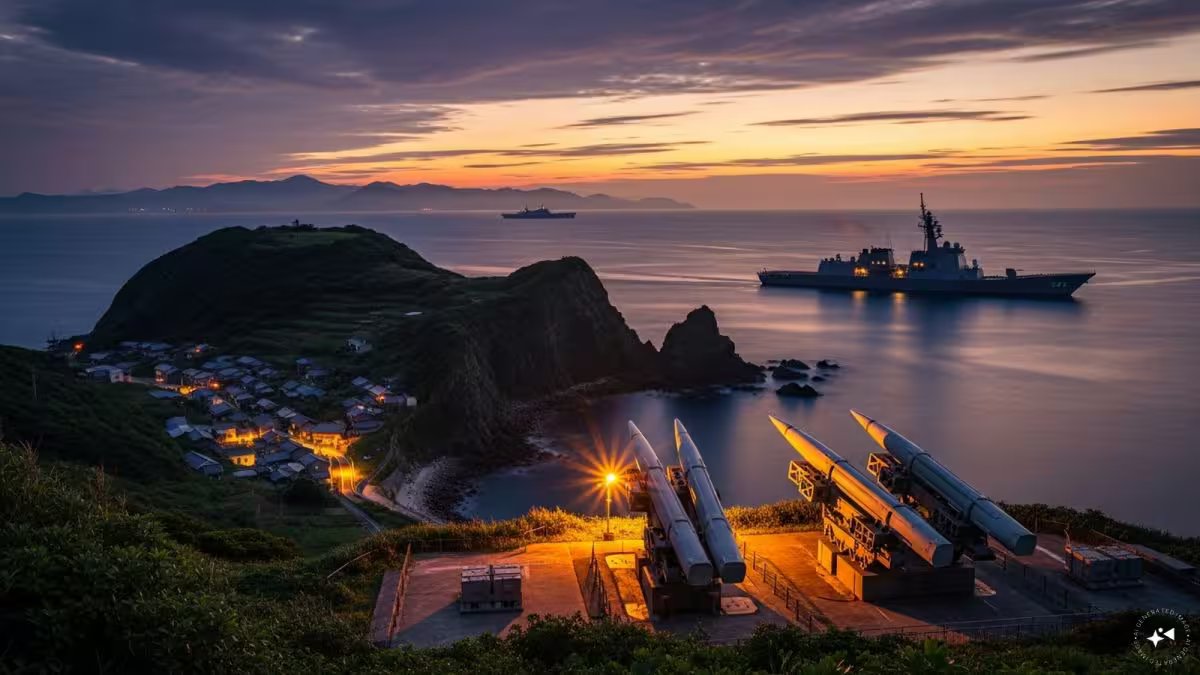
According to the report, across the 160-island Ryukyu chain, Japan is deploying missile batteries, radar systems and ammunition depots, while also expanding major military assets on Kyushu, including F-35 fighter jets and long-range missiles.
The buildup comes as Beijing steps up pressure on Prime Minister Sanae Takaichi over her recent remarks suggesting Japan might intervene militarily if China were to attempt to seize Taiwan. Last weekend, tensions spiked after a Chinese fighter reportedly locked its weapons-targeting radar on Japanese aircraft.
“China’s People’s Liberation Army is undoubtedly building up its ability to force Taiwan into submission,” Bloomberg quoted Koichi Isobe, a former lieutenant general in Japan’s Ground Self-Defense Force, as saying.
“Japan, the United States, and other Western countries must show China their strong resolve to oppose any actions that seek to change the status quo,” Isobe added.
Buildup rattles locals
Once better known for wild horses and diving sites, Yonaguni has transformed since the establishment of a military base in 2016. New housing blocks now accommodate troops, and about 30 additional personnel are set to join the nearly 230 already on site to accommodate an electronic warfare division, and more are expected to follow with the planned deployment of anti-air missiles.
The buildup has rattled some residents. About 80 locals attended a recent community meeting seeking clarity on the government’s expanding plans.
While several voiced concerns about the risks that increased militarisation could bring, others argued that growing Chinese activity near the island leaves Japan with few options, reported Bloomberg.
“Right now we’re defenceless,” Bloomberg quoted Shigeru Yonahara, a car mechanic and town council member, as saying.
“We need the electronic warfare unit to disable threats like drones,” Yonahara added.
No policy shift on Taiwan
Takaichi has insisted Japan has not altered its Taiwan policy, but her comments have again highlighted how closely Japan’s security is tied to events across the strait.
A 2015 reinterpretation of Japan’s pacifist constitution allows the Self-Defense Forces to aid allies — primarily the United States — if Japan’s survival is deemed at risk.
Security analysts say any US-led defence of Taiwan would almost certainly draw in Japan.
“If we decline the US request, that would mean the end of the alliance,” said Kyoko Hatakeyama, a former government analyst, told Bloomberg. “And the United States might not even protect Japan in the case of China’s attack on Japan,” Hatakeyama added.
Beijing challenges Japan’s territorial claims
According to the Bloomberg report, China has revived World War II-era declarations to challenge Japan’s current territorial claims, citing the Potsdam and Cairo Declarations as evidence that Beijing holds sovereignty over Taiwan and possibly parts of the Ryukyu chain.
A Chinese Foreign Ministry spokesman recently quoted the 1945 Potsdam Declaration, which limited Japan’s sovereignty to its four main islands “and such minor islands as we determine.”
Japan, the US and Taiwan reject this view, pointing instead to the 1951 San Francisco Peace Treaty, which compelled Japan to renounce claims to Taiwan but did not assign sovereignty to any specific state.
The treaty also placed the Ryukyus under US administration until their return to Japan in 1972.
Beijing’s state media has amplified narratives questioning Japan’s control of the islands, with some outlets even invoking the idea of Ryukyu independence —comments that have drawn sharp pushback in Tokyo.
Heated debate at home
Japan’s military expansion has sparked intense political debate.
The head of the opposition Communist Party has labeled the strategy a “missile archipelago,” a characterisation rejected by Defence Minister Shinjiro Koizumi, who argues the deployments are aimed at strengthening deterrence.
During a visit to Yonaguni, Koizumi said stationing medium-range surface-to-air missiles on the island would help “reduce the likelihood of attacks on Japan.”
The issue is particularly sensitive in Okinawa, host to the vast majority of US military facilities in Japan and the likely first response point in a Taiwan contingency.
Some residents fear a repeat of the 1945 Battle of Okinawa, including protest organiser Hiroyuki Teruya, who said, “After 80 years, it’s come to this. Are they going to make Okinawa a battlefield once again?”
Others support the broader defence push, arguing China’s posture leaves Japan with limited room for compromise.
“What we’re seeing is a country that won’t accept anything unless its own demands are met,” Bloomberg quoted Ayako Arakaki, a local lawmaker, as saying.
Island politics reflect deeper unease
Yonaguni’s summer mayoral election exposed divisions over the buildup.
New mayor Tsuneo Uechi backs existing electronic warfare and anti-air plans but warns that installing anti-ship missiles like those on nearby islands would exacerbate “psychological stress” for residents.
“These developments are not intended to attack any other country,” Defence Ministry official Kouzou Shimo told residents.
“It is purely for use to defend ourselves in a crisis.”
Former mayor Keniichi Itokazu, however, argues Japan should go further.
“Japan alone cannot defend itself,” he told Bloomberg. “The US–Japan alliance creates the deterrence that prevents China from making moves toward Taiwan or the Ryukyus.”
With inputs from agencies
End of Article