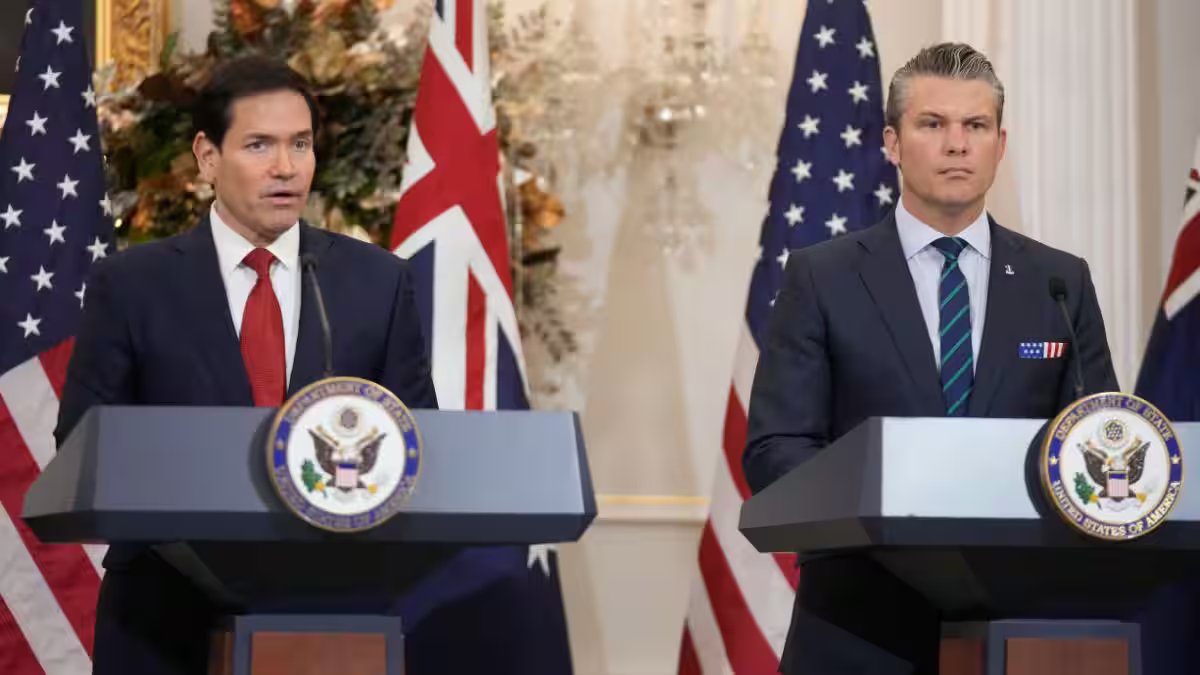
Without mentioning China by name, US Secretary of State Marco Rubio and Defense Secretary Pete Hegseth held talks with their Australian counterparts on the Indo-Pacific. As President Donald Trump has essentially accepted China’s rise under the ‘G-2’ framework, the US policy for China is far from clear.
US Secretary of State Marco Rubio and Defence Secretary Pete Hegseth on Monday met their Australian counterparts for talks expected to focus on security in the Indo-Pacific and countering China’s increasing assertiveness in the region.
However, the administration’s own policy on China remains in question as President Donald
Trump has essentially accepted China’s rise under the ‘G-2’ framework.
In their public remarks ahead of talks with Australian Foreign Minister Penny Wong and Defence Minister Richard Marles, Rubio and Hegseth neither mentioned China nor indicated it would be up for discussion. Instead, they said the US–Australia partnership remained strong.
“This is a very strong partnership. It’s a strong alliance and what we want to do is continue to build on it. We think we have a lot of momentum behind this alliance,” said Rubio, according to Associated Press.
In his remarks, Rubio hailed the cooperation between the United States and Australia on critical minerals, defence production and troop deployments.
ALSO READ:
With ‘G-2’, Trump elevates Xi as equal, carves spheres of influence with China
In the Indo-Pacific, even as the Trump administration has urged allies and partners to step up to contain China, US efforts to tackle China’s rise have almost ceased. Instead, reports have suggested that Trump has scolded Japanese Prime Minister Sanae Takaichi over her refusal to bow to Chinese pressure regarding her country’s stand on Taiwan.
Focus on critical minerals & monetary gain
Instead of China, Rubio focused on critical minerals and supply chains in his remarks.
“We have to have critical mineral supplies and supply chains that are reliable, and that are diverse, and not overly invested in one place where they can be used as leverage against us or our partners of the world,” said Rubio.
In October, the
United States and Australia signed a deal for rare earth metals at a time when China had essentially stopped supplies. But as Trump has entered into an agreement with Chinese President Xi Jinping and essentially accepted China’s ambitions for the Indo-Pacific, it remains to be seen what comes out of the US–Australia rare earth metals deal.
On her part, Wong said that the US–Australia alliance “has always been to ensure it delivers concrete benefits for our security and prosperity and for that of the United States”.
Wong said that Aukus has been central to the commitment to mutual security. She described it as “a win for Australia, a win for the U.S. and a win for the United Kingdom”.
ALSO READ:
Is Trump on a mission to make China great again?
The agreement for the development of nuclear submarines for Australia has survived a Pentagon review amid fears that the Trump administration could axe the agreement. But Hegseth suggested that the monetary benefits to the United States would mean the agreement would stay alive.
Hegseth said that “as we move full steam ahead on Aukus, we applaud Australia’s upcoming delivery of an additional $1 billion to help expand US submarine production capacity”.
End of Article