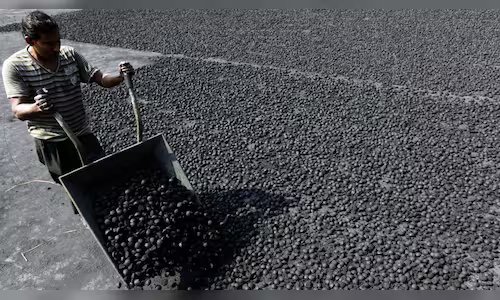
Steel Secretary Sandeep Poundrik has described the lack of growth in the production of steel-grade coking coal as a major challenge to scaling up India’s steel output. He said that discussions are underway with the Coal Ministry to increase the share of domestic coking coal in steel-making to reduce import dependence and bring down production costs.
Assuring that India has sufficient iron ore reserves to meet both domestic demand and export requirements, Poundrik noted that the most expensive raw material in steel-making is not iron ore but coking coal. He pointed out that 90% of India’s coking coal is imported — a reliance likely to increase as steelmaking capacity expands.
According to a September 2025 report by the Indian Steel Association (ISA) and EY Parthenon, India’s coking coal imports are projected to surge 42% to 115 million tonnes by 2030 due to rising demand in the steel sector.
Under the National Steel Policy, the country aims to reach 300 million tonnes of steelmaking capacity by FY2030–31 and 500 million tonnes by 2047. India imported 81 million tonnes of coking coal in FY25, and the demand is expected to rise 55% to 135 million tonnes by FY30, in line with higher capacity targets.
Also Read: Asian Energy Services bags ₹459 cr coal handling plant project in Odisha
Speaking at the CII Steel Summit in New Delhi, Poundrik said that while many nations now treat steel availability as a “national security measure”, there is a need to change public perception of the sector. Contrary to the belief that the industry is dominated by large players, he said around 50% of India’s steel is produced by 22,000 MSMEs. He attributed the recent shutdown of 150 smaller players to a five-year low in steel prices.
Highlighting challenges in exports due to trade barriers such as the European Union’s Carbon Border Adjustment Mechanism (CBAM), Poundrik emphasised the need to cut the sector’s carbon footprint. He said the Ministry has launched pilot projects with steel companies to produce Green Steel via the blast furnace and DRI routes, leveraging the expected decline in green hydrogen prices over the next decade.
(Edited by : Sheersh Kapoor)