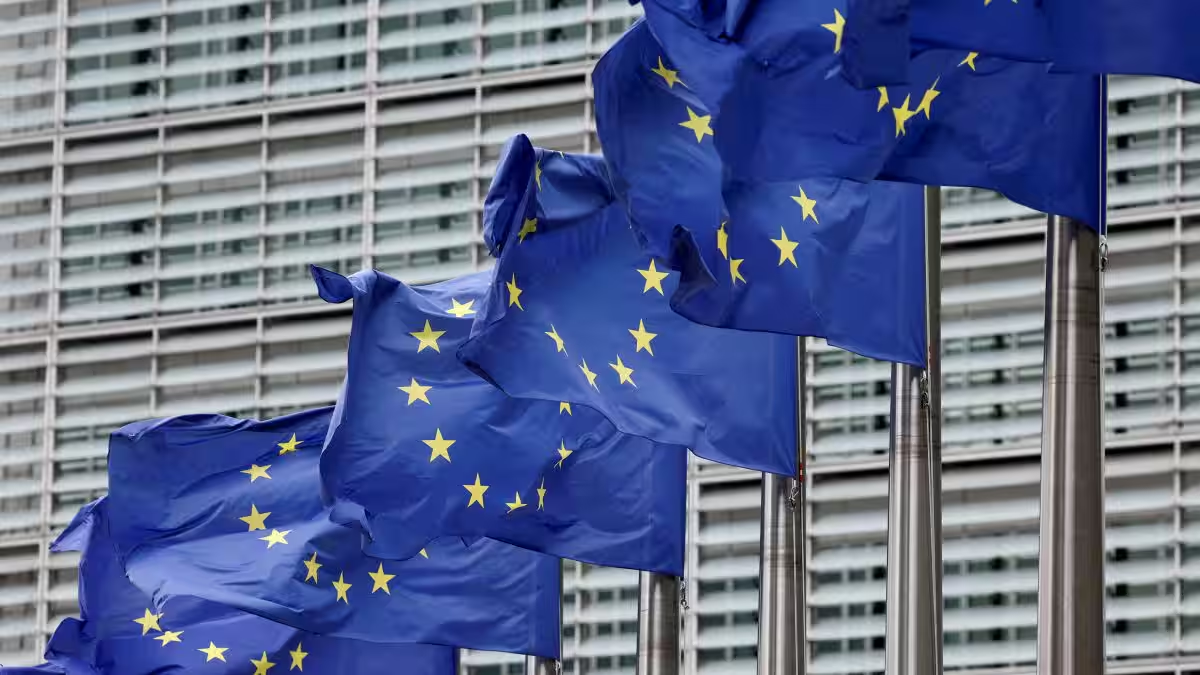
The European Union is weighing renewed enlargement ambitions against geopolitical pressures, uneven candidate readiness, and the need for internal reform.
The European Union, already a bloc of 27 countries and about 450 million people, is once again confronting a familiar but pressing question: should it expand further? With nine countries officially seeking membership and hints from EU officials that some could join by 2030, enlargement has returned to the centre of the debate, watched closely by Russia, the US and China.
In keeping with the EU’s cautious style, the answer is neither a clear yes nor a firm no. The European Commission’s latest progress report highlights a wide gap between political ambition and practical readiness among candidate countries. While Montenegro has quietly completed much of the work required for accession, others such as Albania, Moldova and Ukraine remain far behind, and several are unlikely to join anytime soon.
Strategic and economic case for expansion
If managed carefully, enlargement could strengthen Europe’s security and reinforce its credibility as a democratic bloc. This argument carries particular weight at a time when Russia’s aggression, America’s inward turn, and China’s growing influence have made regional integration a stronger strategic priority. Without expansion, the EU risks being surrounded by fragile and easily pressured states, whose instability could spill across its borders.
The economic rationale is also well established. A previous enlargement round in 2004 raised new members’ gross domestic product per capita from 59 per cent of the EU average to 81 per cent by 2022. Living standards improved markedly, alongside major gains in infrastructure, services, and life expectancy. Existing members also benefited, gaining a larger market, smoother supply chains and greater regional stability, with income per person around 10 per cent higher than it would otherwise have been.
Limits, reforms and the road ahead
These gains, however, are not guaranteed. Any further expansion must be handled with care. Adding smaller countries such as Montenegro and Albania would be relatively low-cost and high-impact, helping stabilise vulnerable regions, strengthen border and migration management, and reward genuine reform efforts. In such cases, the benefits are likely to outweigh the risks.
Ukraine’s bid presents a more complex challenge. Its size, industrial base, and military resilience could eventually make it a strategic asset. Yet the ongoing conflict, extensive reconstruction needs, governance concerns, and political sensitivities complicate the path to membership. A more flexible approach is needed, focusing first on deeper ties through existing arrangements in areas such as trade, energy, customs and regulatory alignment, while keeping full membership as a longer-term goal.
Two broader principles are central to the enlargement process. First, the EU must consider how it uses its leverage. While requirements such as judicial independence, transparency and the rule of law remain essential, leaving candidates in an indefinite waiting period risks undermining the bloc’s credibility and opening space for outside powers. Interim rewards, including earlier market access, sectoral integration, and greater participation in EU programmes, should be paired with clear penalties for backsliding.
Second, the EU itself must reform to remain workable. Expanding qualified majority voting in areas such as foreign policy and sanctions, instead of relying on unanimity, would help decision-making. Strengthening the single market by reducing friction in capital markets, banking, and energy, alongside cutting red tape, is also necessary. Without such changes, even the existing union may struggle to function effectively.
The EU was founded to bind nations together in peace, prosperity and democracy. By approaching enlargement with pragmatism and reform, it could renew that purpose while securing its own future.
End of Article