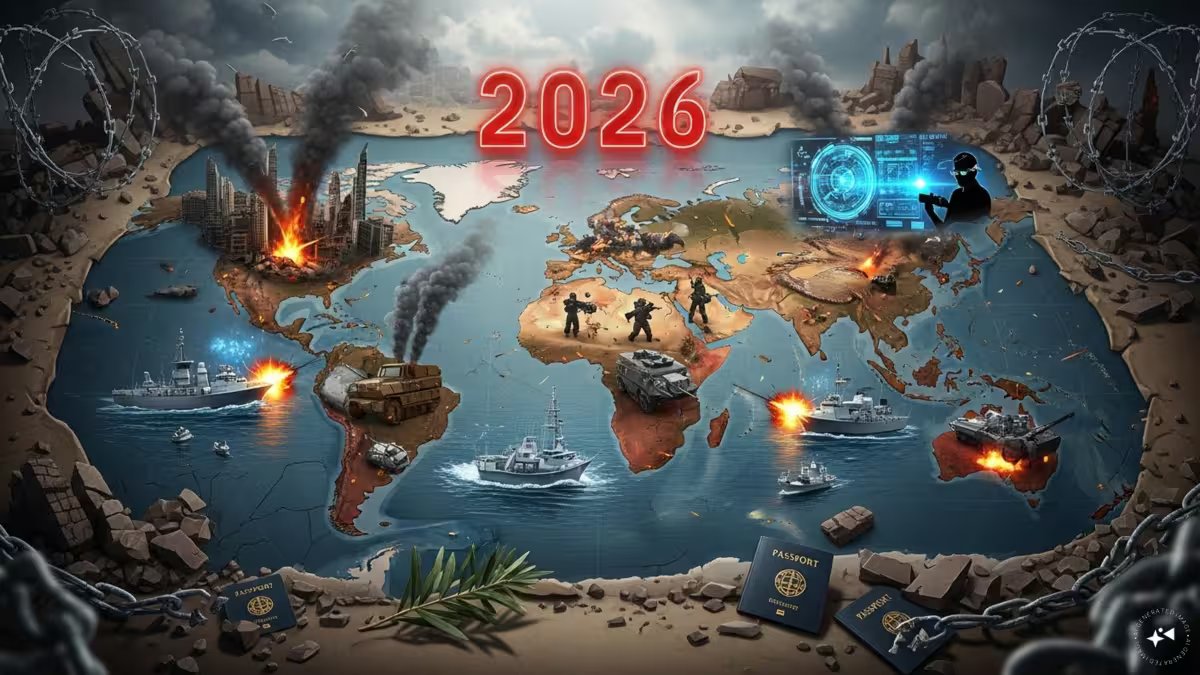
The year 2025 was a turbulent one for the world order, with tensions simmering in several parts of the world. While some were watered down with ceasefire agreements, others persisted and might end up spilling over to 2026.
Over the last year, fighting raged on in Ukraine, Sudan, Myanmar, and the Sahel, as did gang turf battles in Haiti. While the war in Gaza wound down, Israel has resumed its assault in Gaza and has been in talks about the controversial West Bank settlement plan, which has the potential to escalate the conflict.
Tensions are also ripe in Asia, with China and Taiwan sending New Year’s warnings instead of greetings. As we usher in the year 2026, the following are the conflict areas the world should be focusing on.
7 zones where tensions are brewing
1) China vs Taiwan
In his annual New Year’s Eve Speech in Beijing, Chinese President Xi Jinping vowed to reunify China and Taiwan. Speaking the day after the conclusion of intense Chinese military drills around Taiwan, Xi said: “The reunification of our motherland, a trend of the times, is unstoppable.”
It is important to note that China claims Taiwan, a self-governing island, as part of its territory and has long vowed to annex it, using force if necessary. The remarks came at a time when the US intelligence is increasingly concerned about the advancing capabilities of China’s armed forces to launch such an attack if Xi decides the time is right.
In response, Taiwanese President Lai Ching-te vowed on Thursday to defend the democratic island’s sovereignty in a New Year’s speech, after China carried out military drills. “My stance has always been clear: to steadfastly defend national sovereignty, strengthen national defence and whole-of-society resilience, comprehensively establish effective deterrence capabilities, and build robust democratic defence mechanisms,” Lai said in a televised address from the Presidential Office. China’s growing aggression over the island region is expected to be a major talking point in 2026.
2) Russia-Ukraine war and the Baltics
While the US President Donald Trump’s administration has been pushing for a peace deal in the ongoing Russia-Ukraine war. However, Russian President Vladimir Putin warned that Moscow will continue to fight for outright victory in Ukraine, and if Europe wants war, he is ready.
In 2026, many believe that Putin is likely to provoke the European allies of NATO and in the EU at a number of pinch points – especially in the Baltic, the North Atlantic and through the Balkans. There have been several instances of Russian drones breaching the airspace of other nations in the region.
Many are also concerned about the enclave of Kaliningrad, the wedge between Poland and Lithuania, where Russia can shift its focus. In recent months, there have been disruptions of border patrols on the frontier with Norway and Estonia.
When it comes to the Ukraine war, Russia has been clear about its expansionist ambitions. If the US and Europe fail to provide security guarantees to Ukraine, Russia might continue with its aggression in the war-torn nation’s eastern front. As this year would mark the fourth year of the war, the West is hoping to find a just solution, something which is hard to negotiate with Putin.
3) US vs Venezuela
Another major area of conflict is the ongoing tussle between Venezuela and the United States. In late 2025, the US commenced its biggest military buildup in the southern Caribbean in decades. The Trump administration argued that the move was part of a crackdown on drug smuggling and human trafficking.
However, many also noted that the escalation is part of designs to remove Venezuelan President Nicolás Maduro from power. In December, the US Coast Guard began seizing tankers exporting sanctioned Venezuelan crude in a blockade.
While the Trump administration is painting the attacks as a fight to curb drug trafficking. It is pertinent to note that none of the fentanyl ravaging US communities comes from Venezuela. Amid the growing American aggression, Venezuela is also ramping up its military presence near its oil reserves.
While a regime overthrow and full American invasion are highly unlikely, the tensions between the two sides are likely to continue in 2026. However, opposition voices within Venezuela are also becoming prominent, making many wonder if Maduro will stay in power until the end of 2026.
4) Israel’s aggression in Gaza and the West Bank
One of the key events of the year 2025 was the historic ceasefire deal between Israel and Hamas to end the war in Gaza. The deal, brokered by US President Donald Trump, calls for the withdrawal of Israeli troops from Gaza, the establishment of the International Stabilisation Force and the disarmament of Hamas.
The third criterion has been a matter of contention for a while now. Meanwhile, there have been reports of Israeli attacks in Gaza and infighting within the Palestinian militant groups. Hence, tensions are likely to spill over in 2026.
Meanwhile, in the West Bank, Israeli Prime Minister Benjamin Netanyahu’s government has accelerated land seizures and institutional changes seemingly designed to make de facto annexation a permanent reality. The Trump administration and the United Arab Emirates—the Arab government with the closest ties to Israel—have denounced the idea of such a move, as has almost every other capital friendly to Israel. Yet Tel Aviv continues to maintain a harsh stance on the Palestinian territory.
Apart from this, Israel’s strikes on Lebanon, Qatar and even Iran have escalated tensions in West Asia.
5) Africa
A turbulent region in Africa is on the verge of full-blown warfare from Kurdistan in the north to the Arabian Peninsula, Sudan and Somalia across sub-Saharan Africa. When it comes to this region, Yemen and Sudan are the proxies of the two biggest powers of the Gulf, Saudi Arabia and the UAE; the two nations are in open war.
It is also important to note that the fighting on the borders of Rwanda and the Democratic Republic of Congo has strategic implications, given the contest for minerals such as rare earths and cadmium, between the agents of China, Russia’s former Wagner group, and powerful organised crime gangs.
6) Iran vs Israel & the West
In June last year, Israel and the US’s strikes on Iran’s three nuclear facilities led to two weeks of hostilities in the region. The conflict eventually led to Iran shutting its doors to any form of international inspection of its nuclear facilities, raising concern among the West. Top Western and regional officials are now fearing another round of fighting between the two nations.
In late December, Israel’s Prime Minister Benjamin Netanyahu reportedly briefed the White House on plans for fresh strikes, citing Iran’s stated moves to reconstitute its ballistic missile program. Meanwhile, Trump has also indicated that Iran’s missile and nuclear activity could well precipitate renewed attacks. Hence, there is a possibility of renewed fighting in 2026.
7) Afghanistan vs Pakistan
In October last year, border clashes ensued between Pakistan and Afghanistan after Islamabad attributed a surge in attacks on Pakistani territory to insurgents based across the Afghan border. While a ceasefire is in place for now, militant violence between the two nations continues to persist.
The relations between the two nations have tanked, though, mainly because the Taliban refused to crack down on the Tehrik-i-Taliban Pakistan (TTP). Amid the conflict last year, the two sides agreed to a ceasefire in Doha, Qatar. However, subsequent rounds in Istanbul have not eased bilateral tensions.
As of 2026, the diplomatic ties between Pakistan and Afghanistan remain suspended. Trade has ceased. Islamabad’s actions against Afghan nationals on its territory, including mass deportations, have further angered Kabul. Hence, the tension has been so intense that any strike from either side would lead to yet another conflict this year.
Apart from the ones on the list, there have been tensions brewing between different nations around the world. For instance, there have been infightings in Syria between different militant groups and ISIS outfits while the country’s President Al Sharaa attempts to bring in stability.
Tensions are also high among African nations like Ethiopia, Eritrea, Mali and Burkina Faso. Hence, it is safe to say that while 2025 brought some calm in the world order. These hotspots will remain a matter of concern this year.
End of Article